
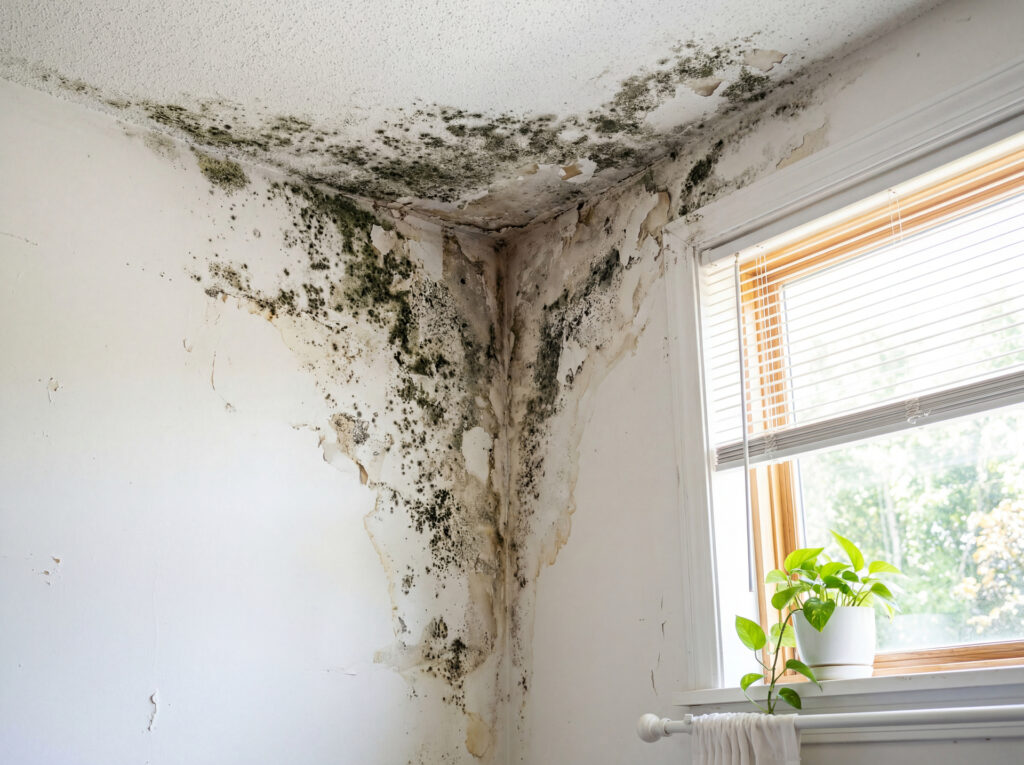
If you have ever returned from a two-week holiday to find mould on a wall, a wardrobe door or the grout in your bathroom, you have experienced something most Singapore homeowners know well. The same trip taken from London, Sydney or Tokyo would be less likely to produce the same result. The difference is not cleanliness or building quality—but the specific combination of conditions that Singapore’s climate creates, and which most of the world simply does not have to contend with year-round.
Reason 1: Humidity That Never Drops Below the Danger Threshold
Mould requires a minimum of 60 percent relative humidity to germinate and spread. Most temperate countries dip well below that threshold during winter and dry months, effectively pausing mould activity for a significant portion of the year.
Singapore, on the other hand, does not have that window. According to the Meteorological Service Singapore, the country’s average relative humidity sits above 80 percent annually, with the most humid month, December, reaching 85 percent. Even on drier days, indoor humidity in Singapore rarely drops below the 70 to 80 percent range without active dehumidification or air conditioning. Every surface in a Singapore home is, at almost any given moment, operating within conditions that support mould growth.
Reason 2: No Dry Season to Break the Cycle
In countries with distinct seasons, dry summers and cold winters do more than just make the weather varied. They function as a natural reset by interrupting the conditions that allow mould colonies to establish and spread. A European home experiencing a mould problem in October may see it stabilise or recede by January simply because the environment stops supporting it.
Singapore has no dry season. Rainfall averages around 2,166 mm annually, distributed across the year with no month that could be described as reliably dry. February is the least rainy month on record, and even then, the humidity remains high. There is no period of suppression. Mould that begins growing in March has the same environmental support in August as it did at the start.
Reason 3: Temperatures That Sit in Mould’s Preferred Range
Mould grows fastest between 20°C and 30°C. Singapore’s average daily temperature is around 28°C year-round, placing it permanently inside that optimal range. Most temperate countries experience this temperature window only in summer, which is why mould problems in those climates tend to peak seasonally.
In Singapore, the thermal conditions that accelerate mould growth are simply the standard conditions of being indoors. There is no cooler season to slow the reproduction cycle, and no sustained cold that can kill off established colonies. The warmth that makes the country comfortable to live in is the same warmth that makes it exceptionally hospitable to mould.
Reason 4: Air Conditioning Creates Condensation Indoors
Air conditioning is not just a comfort measure in Singapore—it is a near-universal feature of residential life. But it introduces a specific mould risk that many homeowners do not account for.
When cool, air-conditioned air meets warm, humid air at walls, windows and surfaces near exterior-facing areas, condensation forms. This moisture collects on walls, inside wardrobes and around window frames, creating damp patches that are out of sight and rarely dried before mould takes hold. In 2025, HDB recorded 240 cases where neighbours’ air conditioning units were directly linked to condensation and mould on walls or ceilings, reflecting a structural issue with high-density living in a humid climate. Poorly maintained air conditioning units compound the problem further as blocked drainage pipes allow water to accumulate and seep into adjacent surfaces.
Reason 5: Dense Housing and Limited Ventilation
The majority of Singapore’s population lives in HDB flats, which are designed for density rather than cross-ventilation. Many units share walls on multiple sides, reducing air circulation, and the floor-to-ceiling layouts in some layouts create enclosed spaces, such as bomb shelters, service yards and built-in wardrobes, where air stagnates.
Poor ventilation means moisture from daily activities like cooking, showering and drying clothes indoors has nowhere to go. It settles on surfaces, raises localised humidity and provides the conditions mould needs to germinate. In countries where homes are built with more natural airflow or where windows are opened through cooler seasons, this cycle is naturally disrupted. In Singapore, it requires deliberate management.
Reason 6: Mould Spores Germinate Faster Here
In conditions that meet or exceed its requirements, mould does not need days to appear. Airborne spores can settle and begin germinating within 12 to 24 hours when dampness is present. At Singapore’s average humidity levels, that dampness is almost always present on porous surfaces. As such, a small water leak, an uncleaned condensation patch or even an inadequately dried wall after heavy rain can initiate a mould colony within a single day.
A Climate Problem That Requires a Consistent Response
The conditions that make mould so persistent in Singapore are structural and climatic, not the result of poor housekeeping. Understanding that is important, because it shifts the approach from reactive cleaning to consistent prevention. Ventilation, humidity control and periodic professional treatment are not luxuries here. In most of the world, they would be optional. But here in Singapore, they are what keeps the problem manageable.
Professional cleaning plays a specific role in this. Removing built-up grime, dust and residue from surfaces and fixtures reduces the conditions mould relies on, and keeps a home easier to monitor for early signs before they spread. Painted walls, however, need a lighter touch. Because wet cleaning risks stripping paint and changing the wall’s texture, these surfaces are dusted instead of washed, preserving the finish while still keeping them clean.
Dustaway’s deep cleaning service covers every room, fixture and surface systematically, targeting the grime and residue that create favourable conditions for mould, with regular attention paid to the areas most prone to dampness. Our team knows where these problem spots like to build up and treats each surface accordingly. For an added layer of protection, our NEA-certified disinfection service can be added on to target bacteria and harmful microorganisms using hospital-grade, child- and pet-safe formulations. Together, these services keep a home consistently maintained against the conditions Singapore’s climate creates. Both are available for HDB flats, condominiums and landed properties.
Book a session that fits your home’s needs. Get in touch with Dustaway for a personalised quote.


 Professionalism